IMPORTANT DATES
| Online registration opening | 3 April 2019 |
| Abstract submission opening | 8 April 2019 |
| Deadline for abstract submission (oral presentation) | 21 June 2019 |
| Oral presentation notification | 11 July 2019 |
| Deadline for abstract submission (posters only) | 30 August 2019 |
| Early bird registration deadline | 12 July 2019 |
| Registration deadline | 20 September 2019 |
REGISTRATION
| Early bird registration fees | Regular registration fees | |
| Until 12 July 2019 | After 12 July 2019 | |
| Students | 250 EUR | 300 EUR |
| Academic (members / non-members) | 350 EUR / 410 EUR | 400 EUR / 460 EUR |
| Non-academic | 600 EUR | 650 EUR |
The registration fees include access to the congress area, exhibition hall and conferences. They also include coffee breaks, lunches (from Monday to Friday), the opening cocktail and the social event. The gala dinner is not included.
Gala dinner: 50€/80€ (registered/accompanying person)
- To register for the BSI-2019 congress, please follow this link and select BSI-2019 in the list of events : Azur Colloque.
Be Careful : registration must be completed in one step. If not, you will have to start again using a different e-mail address.
- We provide you with a Template for your abstract: template.
- To submit your abstract, please follow this link: Abstract submission form.
Registration will close on Friday 30 August 2019.
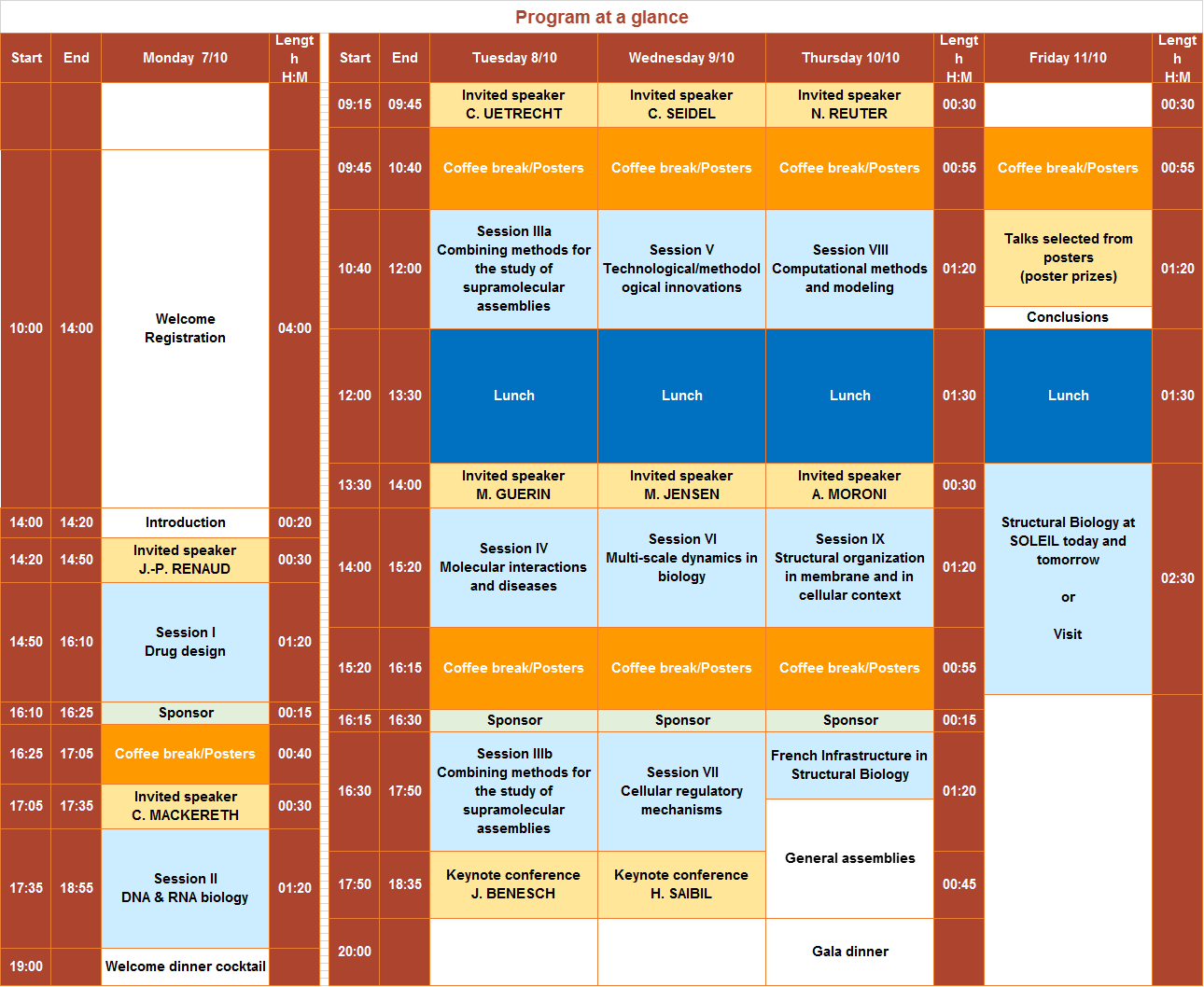
PROGRAM
SPEAKERS
List of invited speakers *
His group’s research impacts broadly the interface between chemistry and the life sciences. Their insights have been important to understanding molecular chaperone (mal)function in humans, and the stress tolerance of plants; and their innovations in mass measurement approaches have provided new means for researchers to quantify biomolecules and their interactions.
Abstract
Abstract
Abstract
Cameron Mackereth is an Inserm research director, whose group is located at the Institut Européen de Chimie et Biologie at the University of Bordeaux. He uses NMR spectroscopy coupled with a variety of biophysical, in vitro and cell biology techniques to study the interaction between proteins and RNA. A major theme in the group is the molecular study of alternative splicing related to development and disease.
Abstract
Abstract
early-stage drug discovery. In 2015, he co-founded Urania Therapeutics(formerly RiboStruct) to leverage the know-how on eukaryotic ribosome crystallography built up by Marat Yusupov and Gulnara Yusupova at IGBMC to develop drug candidates targeting the human ribosome following a structure-based drug design approach.
Abstract
Abstract
Abstract
Abstract
Charlotte Uetrecht studied biochemistry at the University of Potsdam, Germany. She performed her doctoral work in the group of Albert Heck at Utrecht University, the Netherlands. An EMBO longterm fellowship funded her postdoc in Uppsala, Sweden, and at European XFEL, Germany, where she is still working as guest scientist. Since 2014, Charlotte runs her own group at Heinrich Pette Institute, Leibnz Institute for Experimental Virology in Hamburg, Germany. She is well-known for structural, especially native, mass spectrometry of viruses and developing native mass spectrometry as delivery system for X-ray based structure determination.
Abstract
*alphabetical order according to the last name.
COMMITTEES
| Organizing Committee | Scientific Committee |
| BON Cécile (IPBS, Toulouse) | KIEFFER Bruno (IGBMC, Illkirch) |
| CHAVENT Matthieu (IPBS, Toulouse) | LEGRAND Pierre (Synchrotron SOLEIL, Paris) |
| CIOCI Gianluca (INSA, Toulouse) | MARGEAT Emmanuel (CBS, Montpellier) |
| DEMANGE Pascal (IPBS, Toulouse) | MILEO Elisabetta (BIP, Marseille) |
| GERVAIS Virginie (IPBS, Toulouse) | MOUREY Lionel (IPBS, Toulouse) |
| GUILLET Valérie (IPBS, Toulouse) | PEBAY-PEYROULA Eva (IBS, Grenoble) |
| MARCOUX Julien (IPBS, Toulouse) | PEDELACQ Jean-Denis (IPBS, Toulouse) |
| MAVEYRAUD Laurent (IPBS, Toulouse) | SANGLIER Sarah (IPHC, Strasbourg) |
| MILON Alain (IPBS, Toulouse) | SAUTER Claude (IBMC, Strasbourg) |
| MOUREY Lionel (IPBS, Toulouse) | SCHMITT Emmanuelle (Polytechnique, Palaiseau) |
| PEDELACQ Jean-Denis (IPBS, Toulouse) | TIMMINS Joanna (IBS, Grenoble) |
| PLISSON-CHASTANG Célia (LBME, Toulouse) | |
| TRANIER Samuel (IPBS, Toulouse) |
SPONSORS
Industrial














Institutional